
Prepare for emergency situations with private food supplies

Kira Zabe
March 17, 2021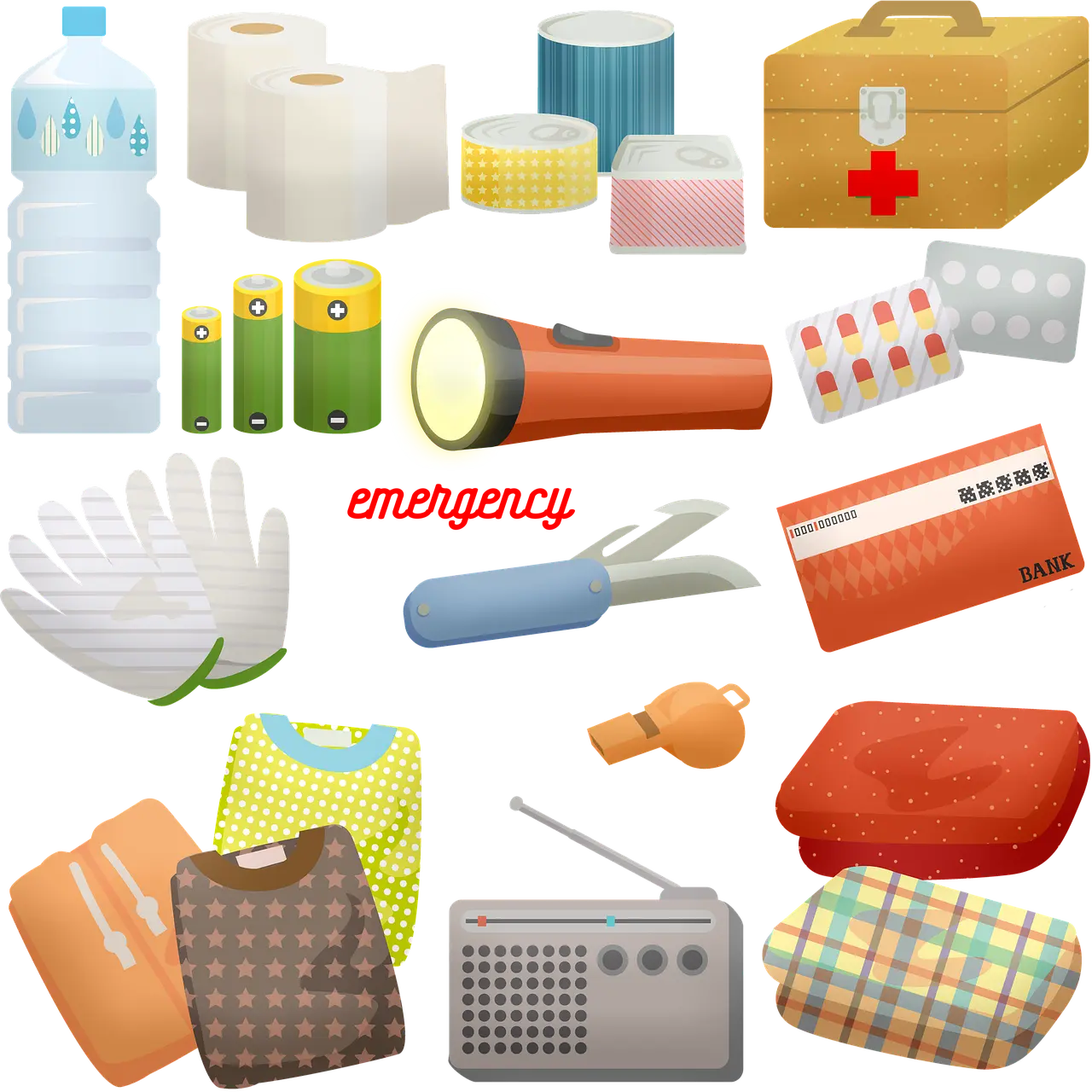
Some people store food at home to prepare before a possible emergency situation.
An emergency supply? That's not necessary! I have a supermarket around the corner!
In our modern world, a reliable supply of food, drinking water and medicines is always guaranteed! What should I prepare for?
Despite sophisticated modern systems, people still find themselves in emergency situations caused by natural disasters. In the news, you can occasionally see pictures of floods and flooded cellars. Soon it is impossible to go to the supermarket and you have to help yourself or your neighbors at home.
Other dangers are earthquakes with collapsing houses, storms with fallen trees and blocked access roads. Snow-covered villages in the mountains or simply blocked roads by snowdrifts.
People living in affected regions are well advised to make provisions for emergencies - by storing the most important items for everyday life, food, water and medicines at home.
What to do in case of a power failure?

At the same time, over the past centuries we as human beings have become accustomed to a constant availability of food from the supermarket, hot water from the tap and light at the touch of a button. A power failure lasting several hours can upset this balance very quickly!
The first thing to fail are the supermarket cooling systems, as they consume a lot of electricity. The cash register systems also stop working. Maybe the supermarket still sells food for cash - if you have any. Unfortunately, the card payment only works with electricity, so that's it. In the worst case the supermarket is empty after a few hours due to panic and hamster purchases. The trucks that fill up the shelves every day also stop running…
You can imagine that such a situation can quickly become unpleasant!
Better prepare for unforeseen events, instead of worrying when it is to late!
With the Prepper App you get a proven method for crisis prevention: Through private provision at home with food, drinks and medication.
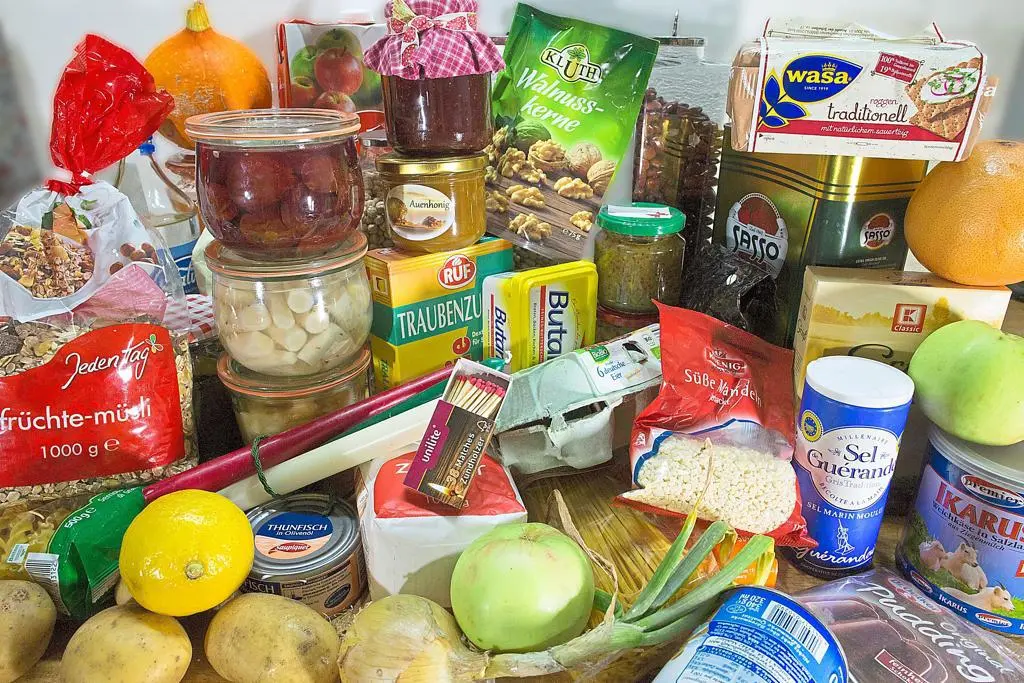
The federal government recommends that food be kept in stock for 10 days. With these food stocks you and your family are already quite well prepared for an emergency - even larger stocks are of course even better!
"Prepping" comes from "to prepare", and is not to be mistaken for panic buying. Finally, it is not about buying until the supermarket shelves are empty, but about carefully choosing and stocking supplies. Like your grandparents did in good old times. Therefore we do not see Prepper as a negative loaded word - but we called our app even Prepper App before 2019. In the mean time, because of added features, we changed the name to Pantry Chief.
How does the Prepper App help with your preparation?
With our app you get a tool that allows you to easily record what food you have at home. And this by means of a barcode scanner. You can also organize the food in storage locations. You always have an overview of expiring or expired food and can exchange it in time. This is a very useful feature especially for large stocks!
Furthermore Pantry Chief supports you with a balanced diet. Sufficient carbohydrates in the form of pasta are certainly a first step, but without a certain amount of protein and fat this would be a rather unhealthy diet.
As the last and most important factor, the Pantry Chief determines how long your supplies will last! For this purpose, you can enter the body measurements for each household member, which are used to determine the individual calorie requirement. Alternatively, you can also enter your own value for the calorie requirement. Now the energy content of all food in your stock will be compared with the energy requirements of your household. This determines the number of days the stock lasts. The same is calculated for the liquid and water requirements.
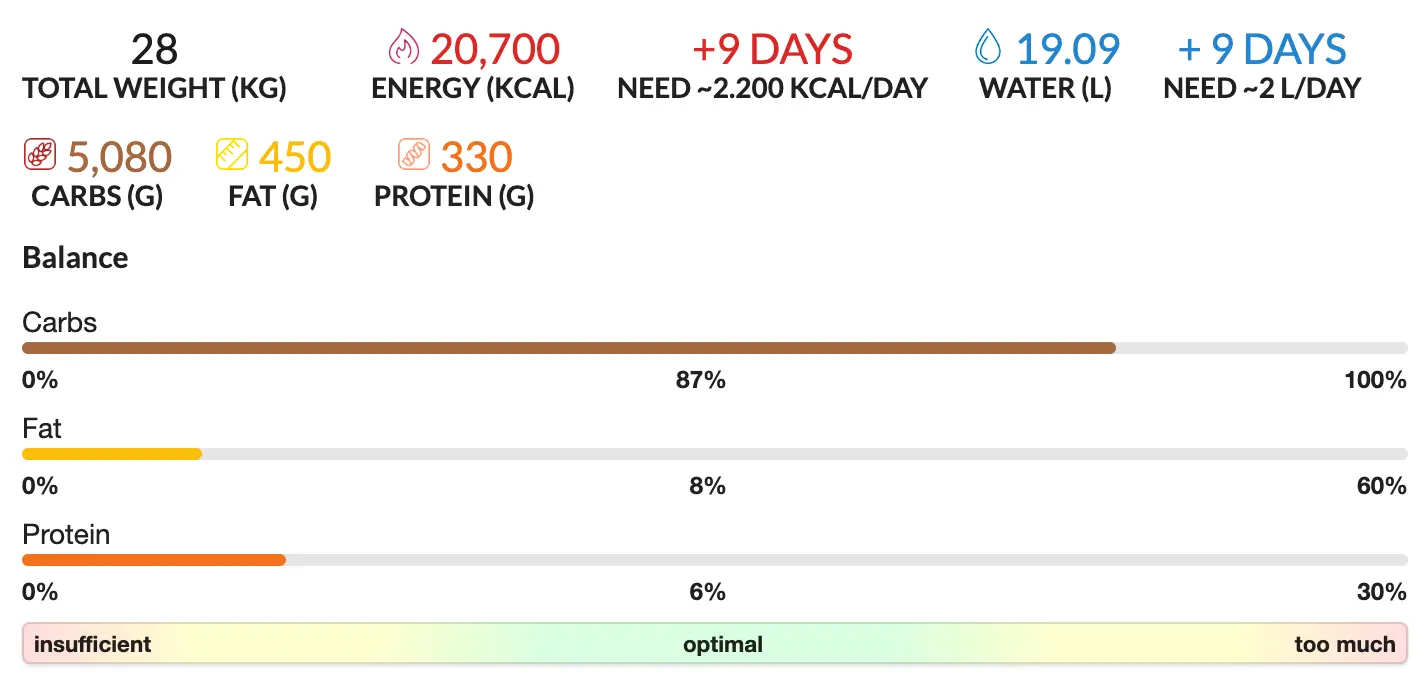
Suppose you want to provide for your family for ten days, as recommended by the federal government. If, for example, your provisions only last nine days, as shown in the picture, you can see exactly what other products you should buy to reach your goal in the nutritional statistics below: A well-balanced stock that will keep for a long time and provide security for a certain time! By the way, the example picture does not contain any fat and protein-containing food - the stock is otherwise too rich in carbohydrates.
Sign up for the app for free today!
New laws on food waste in Spain
Spain has recently passed a groundbreaking law to combat food waste. This law requires all actors in the food chain, from producers to retailers, to implement specific plans to prevent food loss.
Key provisions of the law:
Obligation to donate surplus food: Supermarkets with a floor space of more than 1,300 square meters are now required to form partnerships with non-profit organizations to donate surplus food that is still fit for consumption. These donations are exempt from value-added tax.
Offer of packaging for leftover food: Restaurants and bars are required to provide their guests with free, reusable or recyclable packaging so that they can take home uneaten food. The aim is to raise consumer awareness of food waste and encourage them to take leftovers with them.
Promotion of the sale of products with approaching expiration dates: Retailers should offer products that are nearing their expiration date or have aesthetic defects at reduced prices to encourage their sale and reduce waste.
Hierarchy of priorities for dealing with surplus food: The law establishes an order for handling surplus food. Priority is given to human consumption through donations. If this is not possible, the food should be used for the production of processed products. The last options include using it as animal feed or for energy generation.
Sanctions for violations:
Companies that violate the provisions of the law can expect fines ranging from 2,000 to 500,000 euros.
Critique and Outlook:
While the law is considered an important step in the fight against food waste in Europe, there is also criticism. Some voices argue that the strict framework of sanctions could disproportionately burden companies and that the law does not sufficiently address the role of consumers, who are responsible for a significant portion of food waste.
Nevertheless, the law is seen as a significant advancement in reducing food waste and promoting a more sustainable awareness in society.
Join in and reduce food waste! 🌱📲
Spain's new law demonstrates: Sustainability starts in the pantry! With the Speisekammer App you can keep track of your groceries, plan meals efficiently, and avoid unnecessary waste.
👉 Download the app now and join the movement for less waste and more conscious consumption! 💚 Try it now!
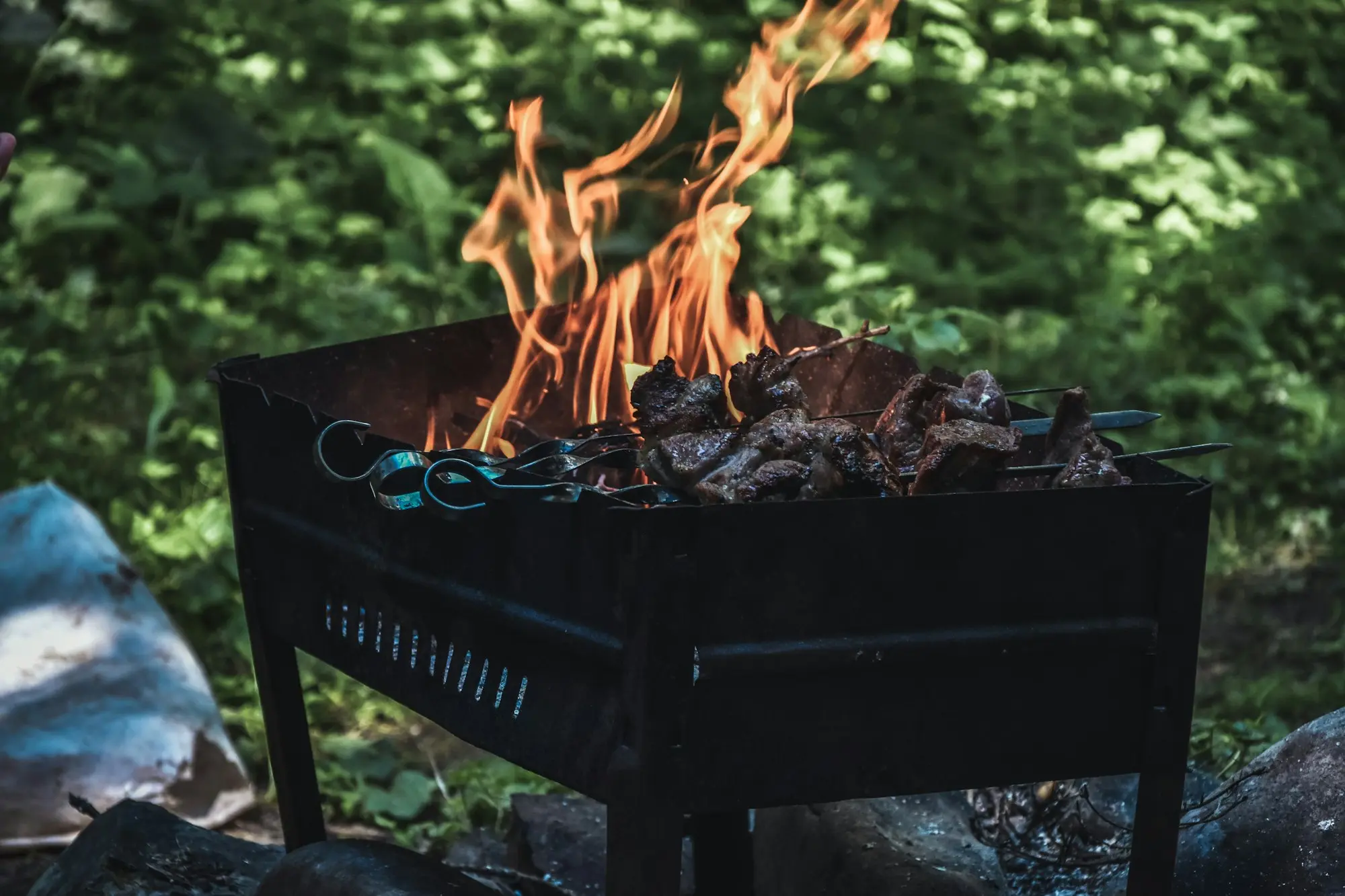
Sustainable barbecue – how to make your BBQ eco-friendly & delicious
The sun is shining, the evenings are getting longer – it's finally BBQ season again! But even when barbecuing, you can save a lot of CO₂, avoid waste, and even be really creative. In this blog, we'll show you how sustainable grilling works – without sacrifice, but with lots of flavor and responsibility. 🌱🔥
1. Shop regionally & seasonally
The foundation for sustainable grilling starts with shopping. Instead of relying on grill classics that have traveled far, it's worth taking a look at what's available locally:
- Seasonal vegetables such as zucchini, bell peppers, corn, or mushrooms are perfect for grilling.
- Fruits like peaches or pineapples add a sweet touch to the grill.
- Regional cheese or Tofu from European organic soy are great alternatives to imported or meat-heavy products.
💡Tip: Use the Smantry App to see what ingredients you have at home and what you can conjure up with them.
2. Less (but better quality) meat
Meat has a high carbon footprint – but you don't have to give it up entirely. Pay attention to:
- Organic quality
- Species-appropriate husbandry
- Regionality
Alternatives such as marinated cauliflower, halloumi skewers, or homemade lentil burgers are not only climate-friendly but also really tasty.
3. Grill without aluminum foil
Aluminum foil is harmful to the environment – and can even be hazardous to health when heated. Instead, use:
- Stainless steel grill pans
- Grill baskets
- Banana leaves or corn husks as natural packaging
- Reusable skewers made of stainless steel or wood
4. Upcycling Recipes: Smartly Repurposing Leftovers
After barbecuing, there's often something left over. Here are a few ideas:
- Grilled vegetables can be turned into a salad or wrap the next day.
- Bread leftovers are turned into crispy croutons.
- Fruit leftovers are perfect for a fruity iced tea or sorbet.
The Smantry App helps you keep track even after the BBQ – and avoid wasting food.
5. Conscious Grilling: Ambiance over Mass Production
Sustainable grilling also means: Less is more.
- Eat consciously, instead of preparing extra-large portions
- Plan your shopping efficiently and without excess with the app
- Avoid single-use products like plastic cutlery or paper plates – a BBQ is more enjoyable with nice dishes anyway!
In conclusion: Sustainable grilling is easy – with the right planning
With a little preparation and creativity, your barbecue will not only be delicious, but also good for the environment. And the best part: You don't have to make any compromises. The Smantry App helps you to use everything you already have – for less waste and more enjoyment.
🔥 Open the app now, check supplies, and grill sustainably!
Have fun with your barbecue –
your team at Smantry 🍢🌽♻️

Ice cream from leftovers? Here's how to make homemade zero-waste ice cream! 🍦♻️
Even better: You can easily make your own ice cream using ingredients that might otherwise end up in the trash. Overripe bananas, leftover yogurt, or the last bit of almond milk – all of these are perfect for whipping up a delicious and sustainable ice cream in no time.
Why homemade ice cream?
You know what's inside. No additives, no artificial flavors.
You save food. Many leftovers are perfect for freezing.
You save money.Buying ice cream is a thing of the past – your freezer is now the ice cream parlor.
3 simple leftover recipe ideas for ice cream:
🍌 1. Banana Peanut Ice Cream
Ingredients:
- 2 very ripe bananas
- 2 tbsp peanut butter (or other nut leftovers)
- 1 shot of plant-based milk
Preparation:
Slice bananas, freeze them. Then blend with the remaining ingredients – and your creamy Nicecream is ready!
🍓 2. Yogurt Berry Ice Cream
Ingredients:
- 1 cup of plain yogurt
- Leftover frozen berries or fresh berries that have become soft
- 1 tsp honey or syrup
Preparation:
Mix everything and either eat immediately or freeze in ice molds.
☕ 3rd Coffee-Chocolate Slush
Ingredients:
- Leftover coffee from the morning
- 1 tsp cocoa powder
- A piece of overripe banana or some agave syrup
- Ice cubes
Preparation:
Crush all ingredients in a blender – a caffeinated summer dream!
Even more leftovers? No problem!
With Smantry you can see at a glance which ingredients you have at home – perfect for creating your own ice cream. This way, your leftovers can become little summer highlights.
In conclusion:
Leftover utilization has never been so tasty! 🍨
So: Open the freezer, scan the leftovers, and start mixing!
👉 Use the app now and waste nothing
♻️ For the love of your supplies – and ice cream.
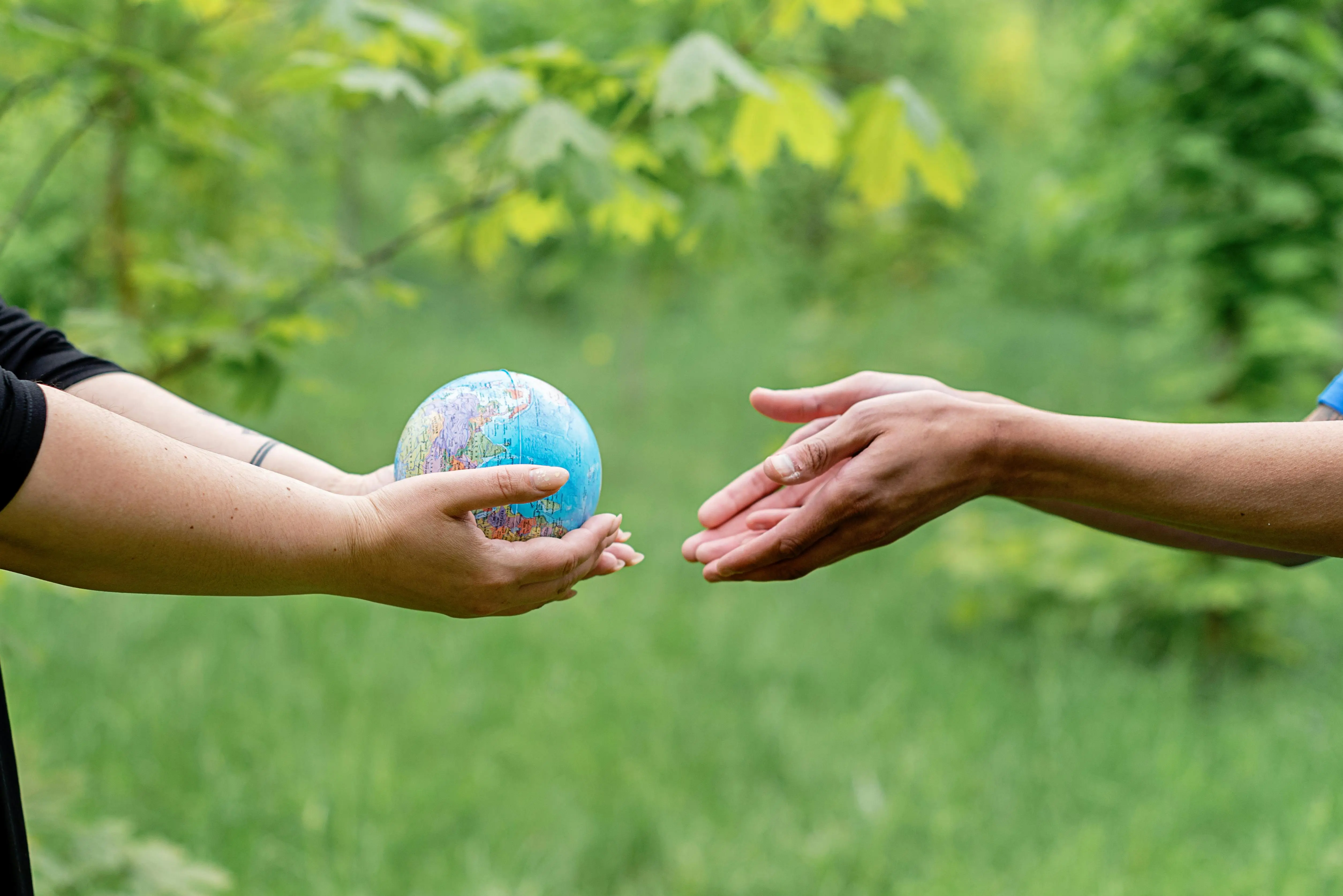
Food waste in international comparison – Who does what?
🇫🇷 France – Legally Against Waste
France is considered a pioneer in the fight against food waste. Since 2016, supermarkets have been prohibited from throwing away edible food. Instead, they must donate or repurpose it. Schools and universities are increasingly focusing on educational programs for sustainable nutrition. As a result, France is now among the countries with the lowest proportion of wasted food in Europe.
🇰🇷 South Korea – Smart Waste Fees
In South Korea, households pay for their food waste by weight – through RFID chips in garbage bins or special garbage bags with barcodes. This financial incentive has led to South Korea now recycling 95% of its organic waste. The system is combined with extensive educational efforts and the promotion of biogas and composting facilities.
🇩🇰 Denmark – The movement comes from below
Denmark relies on the power of the community. Initiatives such as "Stop Spild Af Mad" (Stop Food Waste) have sparked societal debates. Moreover, supermarkets like Wefood exclusively offer food products past their best before date – and at low prices. The acceptance among the population is high, and schools are actively incorporating the topic as well.
🇯🇵 Japan – Tradition Meets Technology
In Japan, food waste is also culturally associated with a strong sense of shame – this helps. Additionally, there is a focus on innovation: companies use AI for better inventory planning or apps that indicate when food should be consumed in the household. Bento shops also use data to precisely adjust their offerings to the daily demand.
🇩🇪 Germany – Between Movement and Potential
Germany is making progress: Initiatives such as Too Good To Go, Foodsharing or apps like the Speisekammer App / Smantry help to reduce waste in everyday life. Legally, however, it is not as advanced as France – although the pressure is increasing. 40% of the wasted food occurs in private households – this shows how important individual solutions are.
🌍 What we can learn from it
Whether through smart technology, legal requirements, or social movements: the fight against food waste needs many perspectives – and all are important. The good news: every single step counts.
With the Speisekammer App / Smantry you can start right at home – with smart pantry management, reminders for expiring food, and clever shopping planning.
👉 Discover the app now and make your contribution: smantry.com